“双碳”助力显著 | 国鸿氢能登上全球顶级期刊《Nature》
3月24日,全球顶级期刊《Nature》(中文:《自然》)刊发“中国双碳”专题文章《中国氢燃料电池迈向绿色未来》,对国鸿氢能和鸿基创能携手推动中国氢燃料电池的大规模商业应用,助力双碳目标的实现进行了特别报道,该文同时在Nature官网刊登发布。
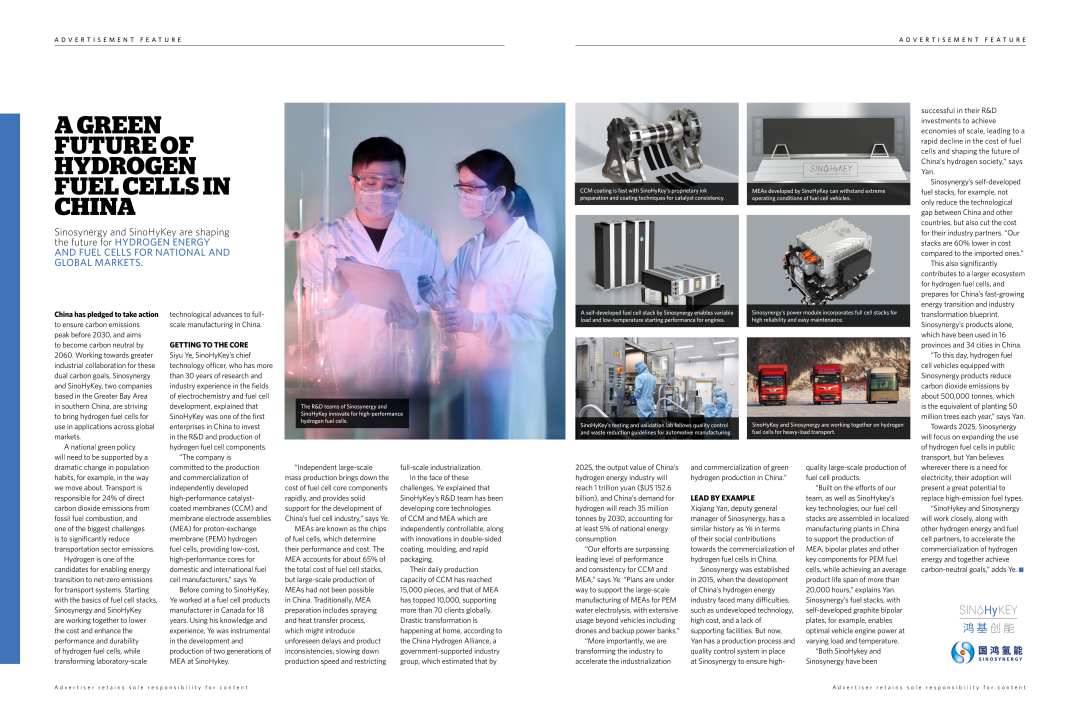
▲全球顶级期刊《Nature》的报道全文

▲Nature 官网报道截图
《Nature》是在学术界享有盛誉的国际综合性顶级科学周刊,以报道科学世界中的重大发现、重要突破为使命,彰显顶尖科研成果和卓著的科学贡献。此次专题报道,代表了《Nature》对国鸿氢能和鸿基创能在推进实现中国双碳目标取得成效的高度认可。
国鸿氢能是以氢燃料电池为核心产品的高科技企业,致力于为社会提供优质的氢燃料电池产品和完善的系统解决方案,搭载公司产品的氢能汽车近5000辆,覆盖中国16省34地区,累计行驶超1.2亿公里。
鸿基创能是国内首家实现氢燃料电池膜电极产业化的企业,致力于质子交换膜燃料电池用高性能膜电极(MEA)的大规模国产化和产业化,解决了中国燃料电池核心材料依赖国外技术的“卡脖子”问题,鸿基创能的CCM日产能已达到15000片,而膜电极则突破了日产能10000片,供给全球超过70多个客户。
伴随着中国“双碳”目标的提出和《氢能产业发展中长期规划(2021-2035 年》的重磅出台,氢能产业的发展被认为是实现能源变革和“双碳”目标的重要路径。《Nature》在文章中提到,国鸿氢能和鸿基创能从燃料电池电堆起步,在致力于降低成本的同时,提高氢燃料电池的性能和使用寿命,并推动从实验室技术突破到大规模国产应用的落地,为构建以氢燃料电池为代表的全方位生态圈做出了重大贡献,勾勒了中国能源和产业转型的快速发展蓝图。
以下为报道全文
A GREEN FUTURE OF HYDROGEN FUEL CELLS IN CHINA
中国氢燃料电池迈向绿色未来
Sinosynergy and SinoHyKey are shaping the future for HYDROGEN ENERGY AND FUEL CELLS FOR NATIONAL AND GLOBAL MARKETS.
国鸿氢能和鸿基创能正在中国乃至全球市场中塑造氢能和燃料电池的未来
China has pledged to take action to ensure carbon emissions peak before 2030, and aims to become carbon neutral by 2060. Working towards greater industrial collaboration for these dual carbon goals, Sinosynergy and SinoHyKey, two companies based in the Greater Bay Area in southern China, are striving to bring hydrogen fuel cells for use in applications across global markets.
中国已承诺采取措施并确保在2030年前实现碳达峰,并争取在2060年前实现碳中和。为实现“双碳”目标,位于中国南部大湾区的两家公司-国鸿氢能和鸿基创能致力于加强产业合作,并努力将氢燃料电池的应用推广到全球市场。
A national green policy will need to be supported by a dramatic change in population habits, for example, in the way we move about. Transport is responsible for 24% of direct carbon dioxide emissions from fossil fuel combustion, and one of the biggest challenges is to significantly reduce transportation sector emissions.
国家的绿色发展政策需要全民的支持,包括生活习惯的改变,比如人们的交通出行方式。作为碳排放大户,因化石燃料燃烧直接产生的二氧化碳排放量中,交通运输高达24%,因此降低这类排放成为减排过程中的最具挑战的一环。
Hydrogen is one of the candidates for enabling energy transition to net-zero emissions for transport systems. Starting with the basics of fuel cell stacks, Sinosynergy and SinoHyKey are working together to lower the cost and enhance the performance and durability of hydrogen fuel cells, while transforming laboratory-scale technological advances to full-scale manufacturing in China.
氢能是交通行业实现“净零”排放的路径之一。从燃料电池电堆起步,国鸿氢能和鸿基创能致力于在降低成本的同时,提高氢燃料电池的性能和使用寿命,并推动从实验室技术突破到大规模国产应用的落地。
GETTING TO THE CORE
精准触达技术核心
Siyu Ye, SinoHyKey’s chief technology officer, who has more than 30 years of research and industry experience in the fields of electrochemistry and fuel cell development, explained that SinoHyKey was one of the first enterprises in China to invest in the R&D and production of hydrogen fuel cell components.
鸿基创能的首席技术官叶思宇在电化学和燃料电池领域拥有30余年研发和产业化经验,据他介绍,鸿基创能是国内最早在氢燃料电池领域布局的公司之一。
“The company is committed to the production and commercialization of independently developed high-performance catalyst-coated membranes (CCM) and membrane electrode assemblies (MEA) for proton-exchange membrane (PEM) hydrogen fuel cells, providing low-cost, high-performance cores for domestic and international fuel cell manufacturers,” says Ye.
“公司致力于质子交换膜(PEM)燃料电池用自主化高性能催化剂涂层膜(CCM)和膜电极组件(MEA)的产业化和商业化,并为国内外燃料电池制造厂商提供低成本、高性能的核心组件。”叶思宇说。
Before coming to SinoHyKey, Ye worked at a fuel cell products manufacturer in Canada for 18 years. Using his knowledge and experience, Ye was instrumental in the development and production of two generations of MEA at SinoHykey.
在加入鸿基创能之前,叶思宇院士曾在加拿大的一家燃料电池龙头企业任职了18年。凭借多年积累的专业知识和丰富经验,他指导了鸿基创能两代MEA的研发和生产。
“Independent large-scale mass production brings down the cost of fuel cell core components rapidly, and provides solid support for the development of China’s fuel cell industry,” says Ye.
“自主规模化量产迅速降低了燃料电池核心组件的成本,为我国燃料电池产业的发展提供了坚实的支撑。”叶思宇说。
MEAs are known as the chips of fuel cells, which determine their performance and cost. The MEA accounts for about 65% of the total cost of fuel cell stacks, but large-scale production of MEAs had not been possible in China. Traditionally, MEA preparation includes spraying and heat transfer process, which might introduce unforeseen delays and product inconsistencies, slowing down production speed and restricting full-scale industrialization.
MEA是氢燃料电池的“芯片”,决定了电池的性能和成本。在燃料电池电堆总成本中,膜电极占比约为65%。以往的MEA制备包括喷涂和热压转印过程,这些会导致生产中的良品率低和产品不同批次之间的不一致,从而降低了生产效率并限制了量产,因此在中国难以实现膜电极的大规模生产。
In the face of these challenges, Ye explained that SinoHyKey’s R&D team has been developing core technologies of CCM and MEA which are independently controllable, along with innovations in double-sided coating, moulding, and rapid packaging.
叶思宇介绍说,为了应对这些挑战,鸿基创能的研发团队一直在钻研并开发自主可控的CCM和MEA核心技术,并在CCM双面涂布、MEA成型和快速封装等方面不断创新。
Their daily production capacity of CCM has reached 15,000 pieces, and that of MEA has topped 10,000, supporting more than 70 clients globally. Drastic transformation is happening at home, according to the China Hydrogen Alliance, a government-supported industry group, which estimated that by 2025, the output value of China’s hydrogen energy industry will reach 1 trillion yuan ($US 152.6 billion), and China’s demand for hydrogen will reach 35 million tonnes by 2030, accounting for at least 5% of national energy consumption.
鸿基创能的CCM日产能已达到15000片,而膜电极则突破了日产能10000片,供给全球超过70多个客户。据政府支持的产业组织中国氢能联盟预计,到2025年,中国氢能产业产值将达到1万亿元(约等于1526亿美元);到2030年,中国氢气的年需求量将增加至3500万吨,在全国能源消耗中占比至少达到5%。
“Our efforts are surpassing leading level of performance and consistency for CCM and MEA,” says Ye. “Plans are under way to support the large-scale manufacturing of MEAs for PEM water electrolysis, with extensive usage beyond vehicles including drones and backup power banks.”
“我们的努力使鸿基创能的CCM和MEA在性能和产品均一性方面均达到了行业领先水平,” 叶思宇说。“公司目前也在规划量产PEM电解水制氢膜电极的新项目,并将在无人机、备用电源和发电等领域得到应用。”
“More importantly, we are transforming the industry to accelerate the industrialization and commercialization of green hydrogen production in China.”
“更重要的是,我们正在推进产业变革以加速中国绿色制氢的产业化和商业化。”
LEAD BY EXAMPLE
树立行业典范
Xiqiang Yan, deputy general manager of Sinosynergy, has a similar history as Ye in terms of their social contributions towards the commercialization of hydrogen fuel cells in China.
国鸿氢能副总经理燕希强在中国氢燃料电池商业化贡献方面与叶思宇有着相似的经历。
Sinosynergy was established in 2015, when the development of China’s hydrogen energy industry faced many difficulties, such as undeveloped technology, high cost, and a lack of supporting facilities. But now, Yan has a production process and quality control system in place at Sinosynergy to ensure high-quality large-scale production of fuel cell products.
国鸿氢能成立于2015年,那时的中国氢能产业发展面临着技术落后、成本高、配套设施匮乏等诸多困难。而如今,燕希强所在的国鸿氢能已经拥有一套完整的生产流程和质量控制体系,能够确保燃料电池产品的高质量规模化生产。
“Built on the efforts of our team, as well as SinoHykey’s key technologies, our fuel cell stacks are assembled in localized manufacturing plants in China to support the production of MEA, bipolar plates and other key components for PEM fuel cells, while achieving an average product life span of more than 20,000 hours,” explains Yan. Sinosynergy’s fuel stacks, with self-developed graphite bipolar plates, for example, enables optimal vehicle engine power at varying load and temperature.
“凭借我们的努力和国鸿氢能所掌握的关键技术,我们的燃料电池堆产品实现了制造及组装国产化,有力支持了MEA、双极板和PEM燃料电池关键零部件的生产,同时实现产品平均寿命超过20000小时。” 燕希强解释说。国鸿氢能的燃料电池堆采用自主研发的石墨双极板,可在不同负载和温度下实现最佳的汽车发动机功率。
“Both SinoHykey and Sinosynergy have been successful in their R&D investments to achieve economies of scale, leading to a rapid decline in the cost of fuel cells and shaping the future of China’s hydrogen society,” says Yan.
“国鸿氢能和鸿基创能在研发方面都成功实现了规模经济效应,促使燃料电池成本迅速下降,助推中国迈进氢能社会。”燕希强说。
Sinosynergy’s self-developed fuel stacks, for example, not only reduce the technological gap between China and other countries, but also cut the cost for their industry partners. “Our stacks are 60% lower in cost compared to the imported ones.”
国鸿氢能自主研发的燃料电池堆,不仅缩小了中国与其他国家的技术差距,同时也为行业合作伙伴节省了成本。“与进口的燃料电池堆相比,我们的燃料电池堆成本降低了60%。”
This also significantly contributes to a larger ecosystem for hydrogen fuel cells, and prepares for China’s fast-growing energy transition and industry transformation blueprint. Sinosynergy’s products alone, which have been used in 16 provinces and 34 cities in China.
而这也为构建以氢燃料电池为代表的全方位生态圈做出了重大贡献,勾勒了中国能源和产业转型的快速发展蓝图。国鸿氢能的产品目前已覆盖中国16个省和34个城市。
“To this day, hydrogen fuel cell vehicles equipped with Sinosynergy products reduce carbon dioxide emissions by about 500,000 tonnes, which is the equivalent of planting 50 million trees each year,” says Yan.
“时至今日,搭载国鸿氢能产品的氢燃料电池汽车,减少的二氧化碳排放量约50万吨,相当于每年种植5000万棵树。”燕希强说。
Towards 2025, Sinosynergy will focus on expanding the use of hydrogen fuel cells in public transport, but Yan believes wherever there is a need for electricity, their adoption will present a great potential to replace high-emission fuel types.
展望2025,国鸿氢能将着力专注扩大氢燃料电池在交通运输领域中的使用。但燕希强相信,对于任何一个存在电力需求的领域,能够替代高碳排放燃料的氢燃料电池都将释放巨大的潜力。
“SinoHykey and Sinosynergy will work closely, along with other hydrogen energy and fuel cell partners, to accelerate the commercialization of hydrogen energy and together achieve carbon-neutral goals,” adds Ye.
“鸿基创能和国鸿氢能将紧密合作,并与其他氢能和燃料电池方面的产业合作伙伴一起,加速氢能商业化,共同实现碳中和目标。”叶思宇补充道。
免责声明:市场有风险,选择需谨慎!此文仅供参考,不作买卖依据。
“特别声明:以上作品内容(包括在内的视频、图片或音频)为凤凰网旗下自媒体平台“大风号”用户上传并发布,本平台仅提供信息存储空间服务。
Notice: The content above (including the videos, pictures and audios if any) is uploaded and posted by the user of Dafeng Hao, which is a social media platform and merely provides information storage space services.”